
Yesterday (Sunday) I went to Pakuwon Mall to check out a diecast exhibition.
There was a Gramedia there, and since I happened to walk past it and was curious about how it looks nowadays, I went in.
Inside, there were newly published manga, whether under Gramedia, M&C, EMK, or other labels.
Until I got interested in one shelf that had manga published by Phoenix Gramedia.
I suddenly remembered that Gramedia and Kadokawa once made a joint company in Indonesia called Phoenix Gramedia.
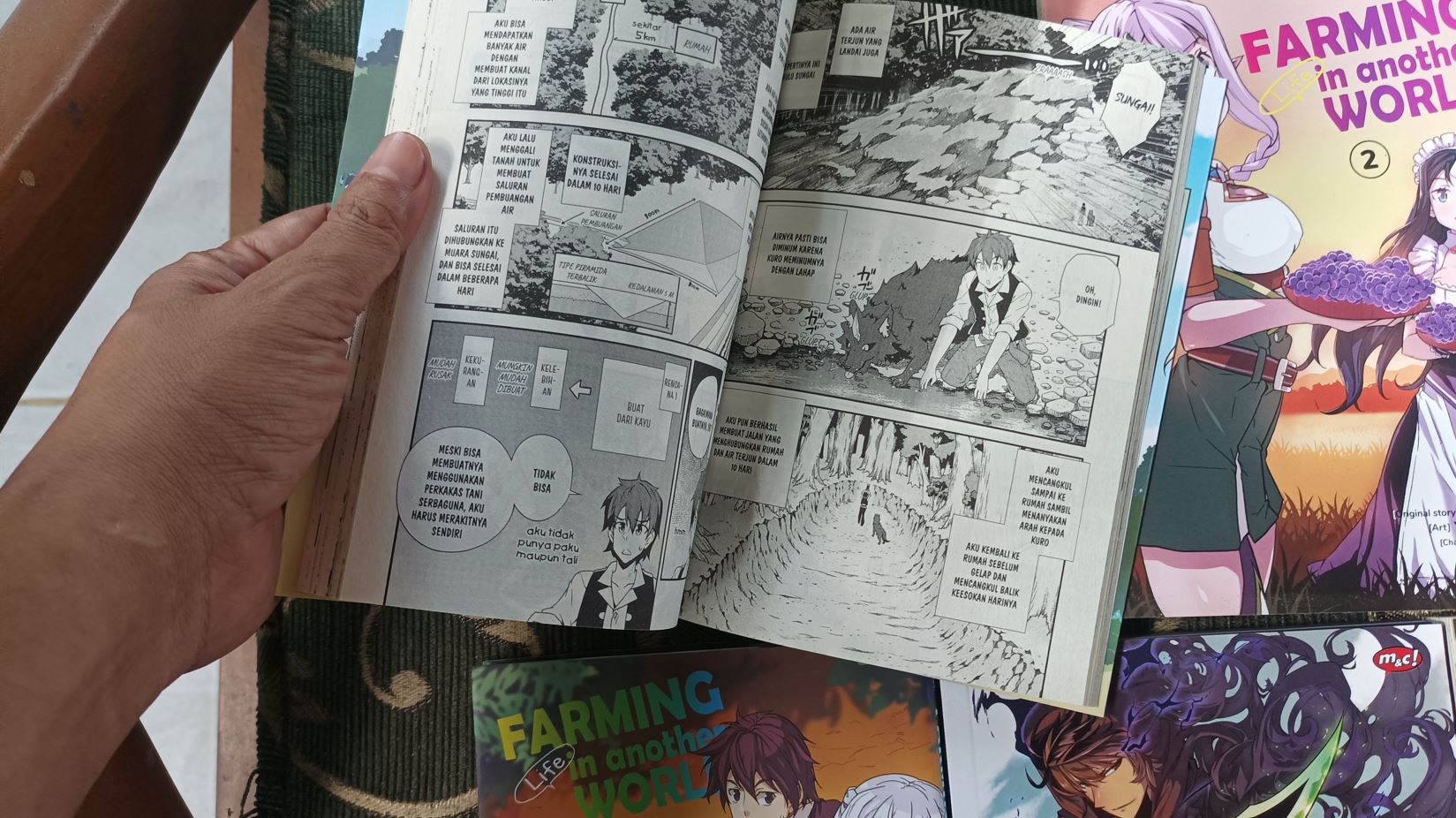
Out of curiosity, I bought Isekai Nonbiri Nouka (Farming Life in Another World), and a Korean manhwa published by M&C, Solo Leveling.
On the book it says “Adult.”
I remembered there were some nude scenes in this manga, but I don’t think it was to the point where it needed an “adult” label. But oh well—everyone has different values and perspectives.
Then I remembered: in the expensive edition of the Evangelion manga, on the early pages there’s a note saying something like “some contents have been altered from the original source.”
And it’s true, they basically censored the nude scenes.
As someone who enjoys originality, I was extremely disappointed. That’s why I stopped buying the following volumes. The appeal of Evangelion manga isn’t just the story but also the art. I really like Yoshiyuki Sadamoto’s drawings. When the art is changed intentionally, to me that’s already ruined.
So now I wondered: Farming Life in Another World has an adult label—so, will this one suffer the same treatment?
I flipped through the pages and found no notice saying “censored.”
But then I remembered that in the early chapters, there’s a scene where Rurushi is naked because she fought with an Inferno Wolf. So let’s check it out!
Okay, turns out there IS censorship.
In the scene where Hiraku meets Rurushi Ruu, several significant panels were altered by the editor:
The panel showing Rurushi’s butt: in the PG (Phoenix Gramedia) version, it’s covered with big sound-effect letters. Originally, those letters were on the right side of the panel overlapping the panel border, but in the PG version they were shifted to cover her butt.


The panel showing Rurushi’s front body: they cropped in (zoomed in) so the crotch area wouldn’t be visible. In the same panel, the curved lines indicating her breast shape were partially removed. The original was zoomed out and the breast outline was visible.


The panel showing Rurushi kneeling and admitting defeat: originally it showed her whole body from the front, but in the PG version the reader’s view is blocked by Kuro (the Inferno Wolf) positioned to Hiraku’s left. In the original, Kuro was on Hiraku’s right, not blocking the view.


On the last page of the chapter where Hiraku meets Rurushi Ruu, a speech balloon covers Ruu’s crotch area. The original also covers it, but the speech balloon was smaller and not centered.


So, will I stop buying this manga? Considering it already costs 65,000 rupiah?
Probably not.
I’ll keep buying the next volumes if my budget allows.
Bruh… this manga costs 65k…
Why? If you stopped buying Evangelion manga (which costs over 100k) because you felt the art was “ruined,” why make an exception for Farming Life in Another World?
Like I said—I like Yoshiyuki Sadamoto’s art.
Meaning I buy Evangelion for three points: the art, the story, and the product presentation.
Because of that, the art becomes extremely important to me—once it’s altered, I consider the product ruined. I don’t care what others think; that’s my stance.
Meanwhile, I bought Farming Life in Another World because I enjoy the story, the product presentation, and the reading experience.
Meaning: I don’t really care about the art. The drawing style isn’t exactly my favorite, but at the same time I don’t have a problem with it either.
Okay, let’s talk about the story.
What is it about?
Isekai Nonbiri Nouka, a.k.a. Farming Life in Another World, is about a guy named Hiraku Machio, a white-collar worker who becomes sickly in his 30s because he worked in a black company that left him no time to take care of his health.
After a long time hospitalized, he eventually dies.
He meets a god, chats a bit, and gets reincarnated into another world.
Because of some requests he made—and the god kind of misinterpreting them, Hiraku spawns in the Forest of Death.
This area belongs to the Demon King, and it’s nearly impossible for humans or weak creatures to survive here: the trees are extremely tough and hard to cut, the soil is too hard and unsuitable for farming, and dangerous beasts and monsters roam everywhere.
Hiraku chooses to be a farmer. The god gives him farming tools that can help him farm, garden, and also serve as weapons for self-defense, including for beating or killing anything or anyone that threatens him.
Starting from the arrival of two Inferno Wolves to his farm area, he eventually meets Vampires, Angels, Elves, Dragons, Dwarves, Beastfolk, Demons, and so on. Hiraku becomes the village chief and lives a peaceful life with his wives and village residents.
Yes, the village chief has to be polygamous because various situations cause or require it.
The storytelling is interesting, if you like reading novels, you might enjoy this manga. The manga is full of Hiraku’s monologue, which feels like narration from a movie narrator.
Because of so many monologues, there’s a lot of text to read per page. Quite a lot, but not too much, and still within limits, not in the “mucho texto” territory that picture-book readers like to complain about.
Yes Togashi, I understand what you’re going for, seriously. But remember, you’re making a manga, not a Hunter x Hunter novel! Hope your health improves.
Next: product presentation.
This is the part where even the 100k Evangelion edition loses compared to Farming Life in Another World.
Did you guys know Farming Life in Another World has a dust jacket?!
YES! <<< That was me yelling when I realized it had a dust jacket.

Japanese manga usually have dust jackets; it’s basically a standard for good-quality books there.
Back then, Elex Media Komputindo also published manga here with dust jackets, though sometimes the folds or sizes were off.
Nowadays, most Indonesian-published manga no longer use dust jackets.
Having a dust jacket on the PG (Phoenix Gramedia) edition makes me feel the money I spent was more… what’s the Indonesian term… “well spent”?
Not only that, the inside of the dust jacket also has interesting bonus reading material.
Next point: paper material.
Honestly, the colored pages look good, but the paper feels too thin, so when glued, it bends slightly.

For the regular pages, they use thicker paper—not cheap grey newsprint anymore.
The thing I’ve hated from local manga printing, ever since the Kung Fu Boy era, is that they always used cheap grey newspaper paper. Over time the paper quality even got worse—expose it to cold and it bends immediately.
Not only that, the grey paper worsened the impression of both text and artwork. Especially the art.
The paper used in Farming Life in Another World is thicker, with a milky-white—maybe slightly beige—color.
This is great, because it makes the printed art look brighter and more classic at the same time.
With the better-feeling paper (not the best—I’ve owned Japanese editions before), the book feels more worth the price.
And I’m serious.
Okay, another example: the Asterix & Obelix comics by Goscinny and Uderzo.
For those who don’t know, these comics have been reprinted several times in Indonesia. But the newest printings kill the colors.
The latest editions use HVS-like matte paper, and the colors look “dead” to my eyes.
But the older editions—whose paper has turned yellow or brownish—have colors that pop, that look “alive.”
The paper wasn’t art paper, but not exactly matte HVS either. At least it looked different in the inked areas, with a slight gloss.
That’s why choosing the wrong print paper can ruin the presentation.
Next: reading experience.
Holy shit, I didn’t expect to enjoy reading Farming Life in Another World this much!
For reference: I’ve already read this manga on scanlation sites. Yeah, call me a pirate if you want—I don’t give a shit.
On every page I flipped, I felt happy reading the text and looking at the art (until I ran into the censored parts, but whatever).
Even when I skipped Hiraku’s monologue, I always changed my mind and read it again.
My eyes felt spoiled by the colors, fonts, and drawings in this manga.
It’s like I rediscovered the feeling and childhood experience of reading Dragon Ball for the first time—pure joy.
The difference is that the curiosity of reading every page is gone because… well, I already read it on scan sites. But that’s not a negative thing for me.

Why?
Because the fact that I still feel happy, even nostalgic like reading comics as a kid, means I’m still having a positive experience even though I already know the story.
Besides, my memory isn’t that strong anymore.
Be mind, I’m already old that much.
So rereading it in a physical book format with good presentation really becomes an enjoyable experience.
Conclusion:
This book is expensive, but worth the price.
Buy it if you have the budget and enjoy stories about the village chief living a relaxed life.